Credit: National Park Seminary and Alexander Co.

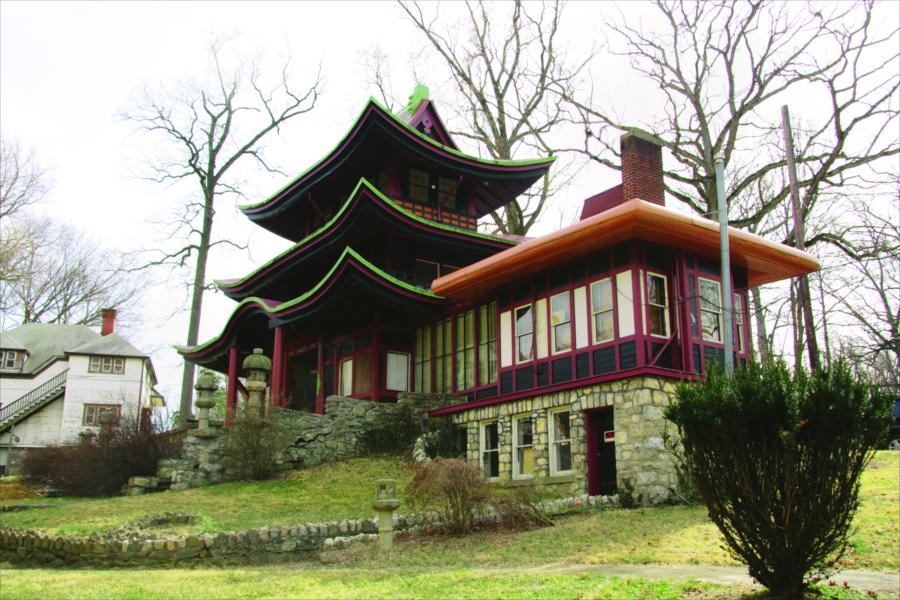
This is D.C.?: A Japanese pagoda (shown here) and English manor-style hotel (below) are among the 23 vintage structures that will eventually be transformed into residences at the National Park Seminary in Forest Glen, Md.

New-construction homes have their pristine drywall and big closets, but secondhand properties often come with something the new ones don’t: delectable stories to tell. Consider the National Park Seminary, a quirky outpost just north of the nation’s capital. Founded in 1887 as a summer resort for Washington’s elite, the 32-acre spot later became a girls’ finishing school. During that era, an eccentric headmaster’s penchant for international flair culminated in sorority houses resembling, among other things, a Japanese pagoda, Dutch windmill, medieval castle (with drawbridge!), and a Swiss chalet. In 1942, the campus was annexed by the U.S. Army as a recuperation point for soldiers returning from World War II, and later Korea and Vietnam. Today, this prime spot bordering D.C.’s idyllic Rock Creek Park is undergoing another reincarnation—this time as a mixed-income residential community unlike any other.

It’s hard to put a price on history, but there’s no doubt it’s worth a premium to a certain subset of buyers. Whether the transformation involves a one-time factory, bank vault, school, or speakeasy, it’s not hard to fathom why building permits for historic makeovers have held steady, even when new-housing starts have come to a grinding halt.

Credit: National Park Seminary and Alexander Co.

Municipalities tend to like such projects because they preserve local character, revitalize blighted areas, boost the tax base, and create local jobs (the lion’s share of restoration must be performed on site). And adaptive reuse is eco-friendly to the extent that it saves demolition waste from landfills, stems sprawl by repurposing urbanized land, and reduces the energy consumption intrinsic to the building process. (It’s estimated that roughly 85 percent of the total embodied energy in the construction equation is expended in the production and transportation of materials to the jobsite.)

But historic reconstruction is not a business for dabblers. Multiple stakeholders, funding sources, and surprises all weigh into the equation. We are pleased to shed some light on the stories behind three such transformations.

Around the World in 32 Acres

Old school kitsch makes a dramatic comeback.

Credit: National Park Seminary and Alexander Co.

ICONIC COLUMNS: Original statuary will continue to serve as structural elements or as outdoor sculptures.

The National Park Seminary faced imminent demise more than once. After two Army bids to raze the property were squelched by preservationists, the buildings sat vacant for 25 years. By the time the current $110 million revitalization effort received approval in 2003, many buildings were on the verge of collapse due to water damage.

“It is unlikely these areas could have withstood another round of spring rains without falling victim to neglect and the elements,” says Chris Gosch, an architectural project manager with Madison, Wis.–based Alexander Co., a master developer specializing in large-scale restorations.

As plumbers ventured into underground crawl spaces to seal off the rusted valves of a decrepit private water system, architects and construction managers hacked their way through crumbling plaster and rotting wood—crowbars in hand—to get a handle on what they were dealing with.

What they found wasn’t an easy fix. None of the buildings’ original framing members conformed to standard sizes. Some were jury-rigged with fastening and bearing methods that would never pass muster with present day building codes. “The challenge was to retain and not disturb historic elements ... while replacing the structural system before it collapsed,” Gosch says. In one building, broken steam pipes had turned a sunny atrium into a lush greenhouse overgrown with ivy and ferns.

Much of the campus remains a work in progress, but prospective buyers have ­already begun to realize its promise. Once transformed, the school’s ­former gymnasium will feature sunken condo units in the space once occupied by the swimming pool (complete with wall mosaics of existing pool tile). Condo residences within the shell of the original hotel will enjoy hammered tin ceilings, arched windows, and authentic plaster wainscoting. A four-story Gothic-style ballroom, housing one of the nation’s last remaining large-scale Victrola speaker systems, will serve as a community space for parties and fundraisers.

Credit: National Park Seminary and Alexander Co.

With the property’s conversion to residential zoning, its larger structures will ­become home to 88 condo residences, 56 workforce housing apartments, and 10 ­market-rate apartments, each meticulously restored by Baltimore-based Struever Brothers Eccles and Rouse, with no two floor plans alike. Bids to transform 11 former sorority houses and other odd buildings into unique single-family homes have been awarded to local contractors. In addition, the campus will include 90 new-construction courtyard townhomes by local builder/developer EYA. And the neighborhood will keep its treasure.

Money Flow: There are two universal truths to large-scale adaptive reuse projects. First, tax credits are a necessary part of the equation, notes Dave Vos, a development project manager for Madison, Wis.–based Alexander Co., the master developer of the National Park Seminary property in Forest Glen, Md. Vos says his firm only pursues projects in the 15 or so states with tax incentives substantial enough (pushing 20 percent) to make large-scale restoration work financially feasible.

Second, the pro formas are typically a mirror opposite of those seen in new-construction projects. “Whereas in new construction your breakdown is usually 40 percent labor and 60 percent materials, the ratio for restoration work is flipped to 60/40,” he says. “You have an existing structure, so you need fewer materials. But that structure needs a lot of work.”

Cool Deal

Savvy planning and recycling take an old warehouse from cold storage to hot property.

Credit: Liam Frederick

desert bloom: With a repurposed structure spanning 413 feet and a density of 19 units per acre, Ice House Lofts helped revitalize a downtrodden area. Land development costs added up to $31,575 per unit. Construction costs averaged $115 per square foot.

It’s not often you come across a brick and concrete building the length of a football field in the middle of the Sonoran desert. Which explains why architect Rob Paulus and some developer friends were quick to snap up the Arizona Ice and Cold Storage Facility (circa 1923) when it came on the market in 2005. Anchored at the edge of downtown Tucson along the Union Pacific Railway tracks, the factory once provided ice for the fruit express heading east out of California, but later fell into disrepair.

“Walking into the building for the first time was like being in a Scorsese film,” ­Paulus recalls. “There was light streaming in through broken glass and a rusted steel floor tub that they used to fill with salt brine. Basically, it had been like a giant bathtub kept at 22 degrees.”

Credit: Liam Frederick

Several bar owners had considered converting the property into a club, but Paulus and his partners had a different sort of renaissance in mind: loft-style housing in a town where there was none. “We looked at possible industrial or mixed uses for the factory, but the problem was it wasn’t really part of an urban area,” Paulus says of the site that would later become the Ice House Lofts. “However, it was big enough that it had its own critical mass and could become its own little neighborhood.”

The partners knew seeding said neighborhood would be a challenge, given that rezoning the Ice House itself would take up to three years. So in the interim, they purchased two small adjacent properties and served up an appetizer of what was to come. Bearing the name Barrio Metalico, the mini project introduced nine urban-style homes featuring corrugated metal siding, raw concrete floors, and exposed ducting. Although they were new-­construction homes, they set the stage for the aesthetic that would later be carried through the warehouse overhaul. “The first unit at Barrio we practically gave away for about $180,000, but the last unit sold for $320,000,” Paulus says. Therein lay confirmation of pent-up market demand for residences with an industrial bent.

Credit: Brad Wheeler

Better with Age: “Anywhere we could, we left the existing building as artifact,” says architect/developer Rob Paulus.

With Barrio Metalico off the boards, buyer appetites were sufficiently whetted by the time the Ice House was ready for rehab. “The existing site included a 1923 brick building, plus two other structures that had been added over time,” Paulus says. “As a result, the original building had five different roof heights, which allowed for some two-story units. Playing with the structural bays gave us the concept of where the larger units would go. We also made sure the larger units had closer proximity to parking.”

Combining the best of old and new, the 48 lofts inside the factory shell maintain their original exposed brick, massive wood beams, and riveted steel trusses. The ­bonus—and what many have been surprised to find in an old building—is energy efficiency, thanks to the original building’s 13½-inch-thick exterior masonry walls, which proved to be a sturdy thermal mass. With the addition of high-performance low-E windows, the project qualified for enrollment in the Tucson Electric Power Comfort Guarantee Home program, which provides residents with an up-front price guarantee on their utility payments (units are blow-tested by power company inspectors before they are sold).

“Tucson has mostly single-family homes, and people don’t realize that just by sharing walls—and in some cases having a unit above you—the energy requirements are far less,” Paulus says. The Ice House Lofts sold out in less than one year.

Credit: Brad Wheeler

Savings Account: Finding new uses for old relics was half the fun at Ice House Lofts. Refrigerant piping from the original factory was powder-coated and converted into pool fencing and bike racks. Salvaged wheel handles from old compressors were reborn as gate handles, and twin water tanks, painted silver, mark the front entryway. “If this were a golf course, you’d have lion statues, but in this context the tanks seemed more appropriate,” architect Rob Paulus says. All told, preservation and reuse of incumbent building materials saved 1,240 tons of concrete and 777 tons of brick from being discarded as waste. Other salvaged materials include:

  • 5,000 feet of 2x10 lumber reused for hallway framing;

  • 4,200 feet of 2x6 lumber used throughout the building;

  • 14,400 square feet of corrugated metal used as fencing for Barrio Metalico, an adjacent property developed by Paulus;

  • 3,600 lineal feet of 2-inch-diameter re-frigerant piping used to create pool fencing and bike racks;

  • 5 lineal miles of 1x7 boxcar shiplap siding used to create courtyard fencing;

  • Ice manufacturing equipment (oldcompressors, etc.) reused as land-marks throughout the property.

Next Chapter

A vintage press building turns a new page.

Credit: Rory Macnish

Freedom of the Press: Decorative brick, 14-foot arched windows, and sleek kitchens made this noted landmark a magnet for buyers seeking urban-style homes in the suburbs. The lofts are just 30 minutes from New York City. Prices range from $370,000 to $705,000.

In its first tour of duty as the printing press and bindery of G.P. Putnam and Sons, the Knickerbocker Press Building produced works by Herman Melville, Edgar Allen Poe, and James Fenimore Cooper. It still has the heavy-equipment scars to prove it. Gouges in the original concrete and wood floors are part of the appeal in a building that now houses 45 true-to-form lofts. With its distinct Flemish parapet walls, cerulean blue window panes, and slate tile roof signage, the landmark is well known to the 100,000 commuters who pass it daily on I-95. Built in 1890, the structure (which many believe to be named after Washington Irving’s Knickerbocker History of New York) was next inhabited by a surgical supply company, and later by working artists. Infill developer Urban Green Builders and luxury home builder Ginsburg Development joined forces in 2000 and used historic tax credits to transform the building to residential rental property.

Its most recent evolution, in September 2007, was a conversion to for-sale condos, each with a live/work option. “The timing was about as bad as you can get,” says Susan Newman, a partner with Knickerbocker New Rochelle, the ownership entity created by the builders. “What was interesting, though, is that we were unable to get all of the units renovated in time for the opening. People started asking if we would sell some of them ‘as is.’”

Standing tenants were given the option to buy or continue renting, after which 36 of the building’s 45 units (ranging in size from 660 square feet to 2,146 square feet) became available for sale. Twenty have sold to date. And while one-fifth of buyers so far have selected the renovation package, a majority have opted for raw, unfinished units and are handling the makeovers themselves. Aesthetically, this option has made for some interesting spaces (one painter is using old sewing machine stands as sink pedestals), although the quirkiest space of all—a five-level watchtower unit built into what was once an elevator shaft—has yet to be sold.

Credit: Rory Macnish

“From a practical perspective, it’s been much easier for us to sell an ‘as is’ unit,” Newman says. “We do a basic upgrade and get everything painted and the floors done, but if we aren’t upgrading the kitchens and baths, a buyer can close on the spot and move in tomorrow. One guy went from contract to closing in about three weeks.”

Softer Side: Loft buyers like a gritty edge, but given its proximity to railroad tracks, an interstate highway, and the parking lots of adjacent buildings, Knickerbocker Lofts felt pretty hard core. “On the one hand, buyers want that industrial feeling. But on the other hand, they want it to feel like home,” says partner Susan Newman. As a solution, the developers ended up creating a tree well for every parking space, along with custom metal planters, which have been allowed to rust to match the building’s industrial style while bringing more greenery to the equation. As the trees mature, their shade will provide units with an extra buffer from the summer sun.

Credit: Susan Newman